
Splits (0xSplits)
Onchain-Zahlungsinfrastruktur für Teams | über 400 Mio. USD gesichertes Zahlungsvolumen | nicht upgradbare, genehmigungsfreie Hyperstruktur | 13+ EVM-Chains
📷 Galerie
OSINT-Profil
Splits — ursprünglich 0xSplits — ist die Onchain-Infrastruktur für Zahlungsaufteilung und Team-Treasuries, gestartet am 15. Februar 2022 im Ethereum-Mainnet von den Mitgründern Abram Dawson und Will Minshew. Der Vertrag ist bewusst nicht upgradbar und genehmigungsfrei (Hyperstruktur): ein kanonischer SplitMain-Vertrag (0x2ed6c4B5dA6378c7897AC67Ba9e43102Feb694EE) plus deterministische Proxys leiten eingehende ETH- und ERC-20-Erlöse automatisch an feste Empfänger weiter. Splits v2 trennt Splitter-Logik und Token-Verwahrung über SplitsWarehouse (unveränderlicher ERC-6909-Wrapper, gleiche Adresse auf allen Chains). Wichtig: Die eigene Website nennt „über 400 Mio. USD gesichertes Zahlungsvolumen“ — das ist kumulativer Zahlungsdurchsatz, keine Seed-Runde und keine Bewertung. Splits ist die Settlement-Schicht im $UM-Radar-Hot-Path, kein Radar-Wettbewerber: unser Vorteil sind Cloudflare Workers plus x402, ihrer ist die Onchain-Verteilung.
🤑 Unit Economics — CAC / LTV (Methode der Investmentbranche)
| Metrik | Wert | Basis |
|---|---|---|
| Payment volume secured (as published) | $400M+ | splits.org homepage, read 2026-09-16 — 'Over $400m in payment volume secured for businesses'. Cumulative distributed throughput, NOT a seed round or valuation. |
| Earlier public floors (context) | >$100M / >$250M+ | Third-party project directories at earlier dates (>$100M distributed to 50,000+ users; >$250M+ across networks) — consistent with a rising curve, not independently re-measured on-chain. |
| Protocol fee (v1 design) | None | Original 0xSplits framing: free to use, no protocol fee, non-upgradable hyperstructure. Current commercial tiers are priced separately on splits.org. |
| Mainnet launch | 2022-02-15 | Launch coverage and project history — Ethereum mainnet. |
| Chain coverage | 13+ EVM chains | Public project directory listing (Ethereum, Arbitrum, Optimism, Polygon, Base, Zora and others). |
| Position in the $UM-Radar stack | Settlement layer | Architecture note, not a measured metric: the radar hot path is Cloudflare Workers + x402; Splits is the onchain distribution primitive a payments flow would settle through. No partnership is claimed. |
🔍 Owner-circulated framing confirmed here: ~$400M protocol throughput is NOT seed capital. The distinction matters because a throughput number is often misread as a raise.
👥 Team & veröffentlichte Führung
Publicly introduced by Splits as one of the two founders; builds protocol and product. Public X handle @abram.
Publicly described as co-founder and co-CEO alongside Dawson; both write code. Public X handle @wminshew.
Publicly described as a small distributed team (single-digit headcount in 2022 coverage; US + Peru). No headcount figure is claimed for 2026 — we did not source one this wave.
Öffentliche Verbindungen (ohne Übertreibung)
Öffentliche OpCo-/HoldCo-Knoten
Multi-sig-style treasury workflows for teams: collect revenue into an onchain account and distribute it on rules, with no paperwork and no company required to receive funds.
Individual onchain payment account surface on the same infrastructure.
Integration surface for builders: use the contracts, SDK and modules directly rather than the hosted app.
The single canonical 0xSplits SplitMain contract, deployed across EVM chains; each Split gets its own deterministic proxy address for composability.
Generic immutable ERC-6909 token wrapper that can hold any native or ERC-20 token for any recipient, deployed at the same address across chains.
PullSplit keeps funds in the Warehouse for pull-flow distribution with built-in accounting; PushSplit pushes to recipients with a generous gas limit and Warehouse fallback on failed transfers.
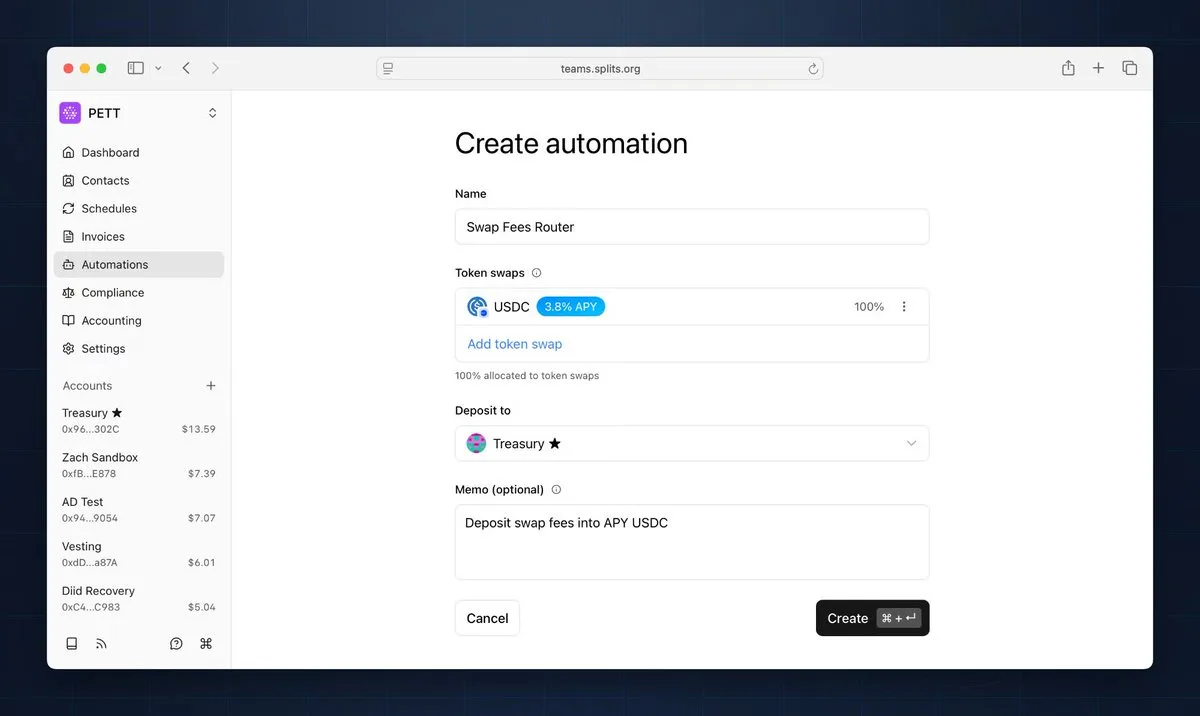
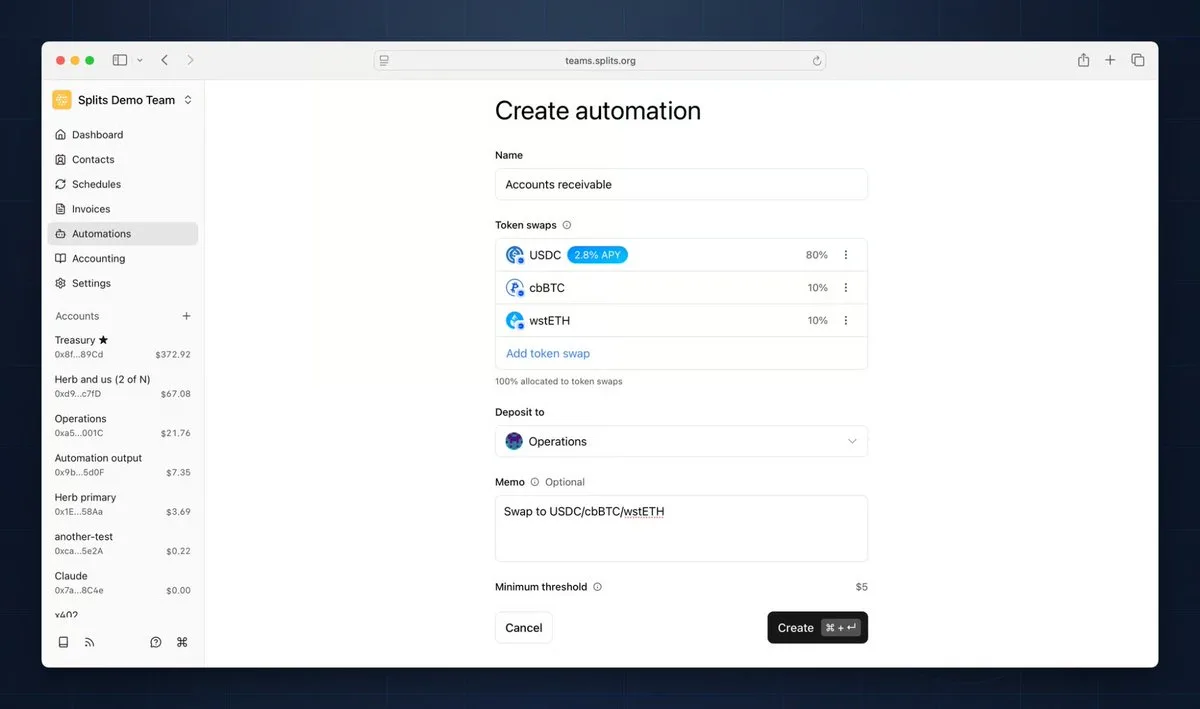
Swapper converts any incoming token into a single output token (oracle starts at Uniswap v3 TWAP, Chainlink planned); Diversifier stacks a Split in front of one or more Swappers so a share of income routes into a different token. Publicly framed as a way to automate tax withholding or salaries.
Send tokens to addresses, ENS names, Farcaster usernames, saved contacts or a connected bank account; multisend to up to 100 recipients with CSV upload, batched under one signature, plus Schedules for recurring payroll-like flows. Private transfers route through NEAR Confidential Intents and hide the payer-recipient link on-chain.
Programmatic API/CLI/MCP access for automated transfers with optional memo and properties, plus llms.txt files so AI agents can read the docs surface.
🗺 $UM-Radar GIS OSINT — Operational Markets
2 geo-pins — live operational-market GIS network on the $UM-Radar vector map
Währungen & Sprachen
🔍 Found by Aleksei Dolgikh @alexdolbun
2026-2036 Öffentliche Alpha-Beobachtungsliste (HYPOTHESE, keine Beratung)
Whether private Sends over NEAR Confidential Intents becomes the default payments path for teams that previously only used transparent Splits — privacy as the funnel, distribution as the durable layer.
Agent tooling (CLI + MCP + llms.txt) as a distribution wedge: if AI agents pick Splits as the payout primitive, throughput compounds without a human in the loop.
HYPOTHESIS, not advice: deterministic per-recipient accounts on immutable contracts either become standing financial infrastructure for teams, or get abstracted away by the smart-account layer above them. Both outcomes are live at the 2036 horizon.
🌐 Anti Fund → Base → $UM-Radar
Dieser Knoten gehört zum öffentlichen Base-/Anti-Fund-Builder-Graphen, den der Radar kartiert. $UM-Radar läuft auf Base: Graph lesen, nächstes Signal abholen, jedes Dossier einzeln in USDC freischalten.
🤖 KI-Agenten — ein Aufruf: GET /api/radar/conductor.json
🔍 Nur öffentliches OSINT. Keine Anlageberatung. Keine Prognosemaschine. $UM ist ein Base-Token — nichts hier ist eine Renditeprojektion.
Nur öffentliches OSINT-Radar. Keine Anlageberatung.